

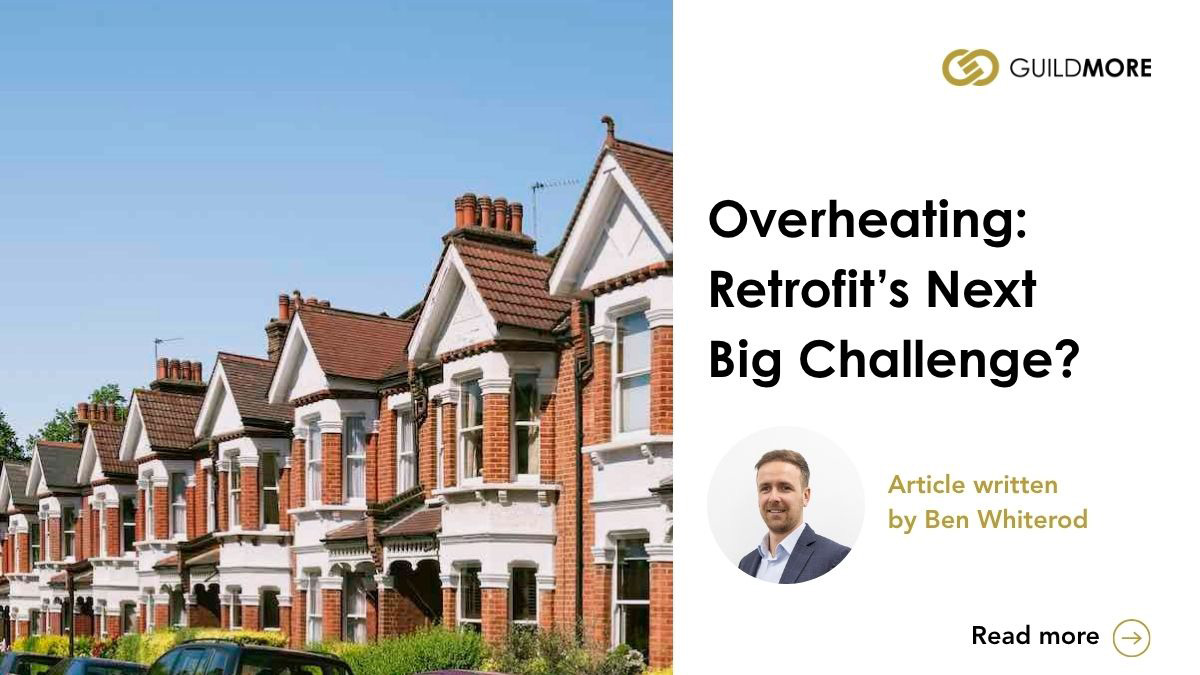
Article written by Ben Whiterod, Head of Retrofit at Guildmore Group
Thermal comfort, airtightness and reducing heat demand have always been high on the retrofit agenda. However, in recent years it has become increasingly apparent that our climate is changing. Summers are getting warmer, heatwaves are becoming more frequent, and some forecasts suggest that within the next decade parts of the UK could experience summer temperatures comparable to those currently seen in cities such as Barcelona.
With this in mind, our approach to retrofit must evolve.
Rethinking Thermal Comfort in a Warming Climate
While ensuring homes remain warm, healthy and energy efficient during winter remains essential, we must also give equal consideration to how those same homes perform during the summer months. As a sector, we need to learn from some of the challenges associated with recent developments where airtightness and high levels of insulation have rightly been prioritised, but sometimes without fully considering the risk of overheating.
And let’s be honest, overheating is no longer a future problem. It’s a current one.
This isn’t a new concept. PAS 2035:2019 Clause 9.2.8 stated that retrofit designs should include measures to inhibit overheating during the installed life of the energy efficiency measures. The 2023 revision goes even further, introducing more explicit requirements around assessing, documenting and mitigating overheating as an integral part of the retrofit design process.
This is undoubtedly a step in the right direction. However, the question remains: how seriously are we taking it, and are we implementing the right interventions today to avoid future problems?
Competing Priorities: The Reality for Social Landlords
The reality is that what we need and what we can afford to do are often two very different things.
Social landlords continue to balance significant competing priorities including retrofit delivery, compliance obligations, fire safety works, damp and mould remediation, disrepair claims and wider asset investment needs. Whilst many of us working within retrofit would advocate for a complete, holistic solution every time, the reality is that this is not always achievable.
So how do we address overheating when funding, programmes and priorities are stretched?
The Way Forward
The answer lies in planning for the future, even when full implementation isn’t possible today.
Where overheating mitigation measures are identified but deferred into future asset investment programmes, robust ownership and governance arrangements must be established. As designers, contractors, consultants and clients, we have a collective responsibility to ensure these recommendations do not simply disappear into a report that sits unread on a shelf.
By taking a more holistic approach, we can ensure the hard work is done now. Risks can be identified, designs developed, options assessed and mitigation measures planned. This provides confidence that future interventions can be incorporated into planned investment cycles and wider asset management strategies when the opportunity arises.
What we cannot afford to do is wait until overheating becomes a widespread problem before acting.
Retrofit has never just been about reducing carbon or lowering energy bills. It is about creating homes that are comfortable, healthy and resilient to the changing climate.
Warm in the winter. Cool in the summer. Well ventilated all year round. Piece of cake… right?
Ben Whiterod is Head of Retrofit at Guildmore Group. With over 15 years of experience in construction and social housing, he is a leading expert in large-scale retrofit and decarbonisation programmes, having worked at a national level from funding strategy and bid development through to delivery and completion.
His background spans social housing decarbonisation, planned investment works and complex multi-site retrofit delivery across the UK.